
Common Disharmonies of Spirit & Mind Illness in Chinese Medicine
In traditional Chinese medicine (TCM), mental or psychological activities are not viewed as solely controlled by the brain. Instead, they are closely connected to the functions of organ system (zang organs) and the flow of qi (vital energy) and blood. There are Five Spirits, known corporeal soul (po), ethereal soul (hun), intellect (yi), willpower (chi) and spirit (shen), that represent different levels of mental activity and are associated with the heart, liver, lung, spleen, and kidney systems respectively. Although each has a unique role, they work together as an integrated system, coordinating thinking, emotion, memory, sleep and behavior. 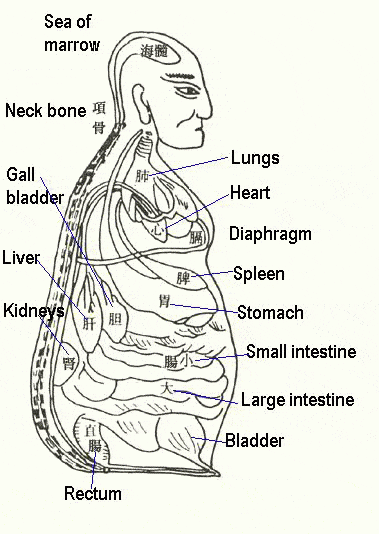
TCM claims that mental activities rely on the body’s fundamental substances—qi, blood, fluids, and essence—as their material foundation, and on the organs and meridians for functional support. When any part of this system becomes imbalanced, it may lead to mental restlessness, confusion, dull perception, poor concentration, memory decline, or impaired judgment. Over time, such disturbances can progress into mental or cognitive disorders, collectively known as spirit and mind illnesses in TCM.
TCM approaches spirit and mind disorders with a holistic perspective. Physicians not only observe mental symptoms but also apply the “four examining skills,” inspection, listening/smelling, inquiry, and palpation, to uncover underlying imbalances in the organs and qi-blood. The ultimate goal of treatment is to regulate the body as a whole, thereby calming the sprit and mind.
Common spirit and mind disorders such as depression, anxiety, and insomnia often lack obvious physical markers in modern medicine. Patients may present with multiple, seemingly unrelated complaints, for example, insomnia accompanied by digestive discomfort, palpitations, or dizziness. In TCM, the diagnostic approach of "syndrome differentiation to find the cause" is particularly suited to these complex and subtle conditions. Generally, TCM diagnostic process for spirit and mind disorders involves systematic differentiation and root-cause analysis through the following steps.
- Gathering clues: Through observation, listening/smelling, inquiry, and palpation, physicians gain a comprehensive understanding of both physical and mental conditions.
- Distinguishing primary and secondary issues: Among numerous symptoms and signs, physicians identify which are primary and which are secondary, clarifying the developmental stage of the disorder.
- Establishing patterns: Using the theoretical framework of organs, qi and blood, symptoms are summarized into specific disharmony pattern.
- Tracing the cause: Physicians determine the root cause of imbalance, including initial triggers and subsequent pathological factors.
- Formulating treatment: Therapy is prescribed based on the identified cause, with dynamic adjustments made according to treatment efficacy.
Simply put, TCM physicians carefully analyze the collected physical and mental data to uncover underlying causes and mechanisms. They do not merely speculate on which aspect of the spirit and mind is disturbed but systematically examine how qi and blood have become disordered, as well as which organ is malfunctioning. Ultimately, this process leads to a personalized treatment plan tailored to the patient’s condition.
Based on the diverse mental manifestations observed in patients, TCM identifies some common causes and disharmony patterns underlying spirit and mind disorders.
Heart: Failure to govern spirit
Heart: Failure to govern spirit
The spirit (shen) associated with the heart is the highest level of mental activity and the ruler of the Five Spirits. When the spirit loses its ability to dominate, command, and control of mental activities, then it will lead to overall mental and psychological disorders, collapse, or loss of control.
Liver: Poor regulations lead to unsettled ethereal soul
| Disharmony | Cause | Mental manifestations |
| Undernourished spirit in heart | Insufficiency of qi and blood to nourish the spirit in heart, often due to overwork or excessive thinking damaging the spleen | Mental fatigue, palpitations, panic attacks, mood swings, restlessness, absent-mindedness, forgetfulness, slow thinking, poor concentration, difficulty falling asleep, vivid dreams and frequent waking |
| Disturbed spirit in heart | Irritated by pathogens such as fire or heat, phlegm-fire, or virtual fire | Feeling agitated and unsettled, inability to focus, irritability, staying awake through the night, dreams disturbed sleep, racing thoughts, and even incoherent speech or manic behavior |
| Obstructed heart orifices | Due to phlegm accumulation, blood stasis, or congestion of heat and stasis | Sleepy, abnormal behavior, slow thinking, indifferent expressions, and even confusion or dementia |
Liver: Poor regulations lead to unsettled ethereal soul
TCM liver stores blood, governs dispersion action, and is responsible for regulating qi flow and emotional activity. Mental activities such as imagination, creative thinking, planning, strategizing, and dreaming are all considered the functions of ethereal soul.
| Disharmony | Cause | Mental manifestations |
| Insufficient dispersion of liver | Strong and persist emotional problems, damp-heat obstruction, or inherent liver deficiency | Depressed mood, sensitivity and suspicion, irritability, slowed thinking, obsessive thinking, difficulty making decisions, impaired imagination, insomnia with dreams and frequent sighing |
| Excessive dispersion of liver | Emotional overstimulation, disturbances of qi movements | Irritability, emotional excitement, feeling unsettled, racing thoughts, impulsiveness, rigid thinking, poor concentration, severe insomnia with disturbing dreams |
| Liver blood deficiency | Insufficient blood to nourish and support the ethereal soul functioning | Timidity and fright, low mood, sentimentality, restlessness, reduced planning ability, weak decision-making, slow thinking, scattered attention, forgetfulness, mental fatigue, dream disturbed sleep and awake easily, dizziness, limb numbness, and even sleepwalking or hallucinations |
| Hyperactivity of liver yang | Yin deficiency causing relative excess of yang in liver | Easily angered but exhaustion and weakness follow emotional outbursts; thoughts are scattered, impulsive, and easily interrupted; hot flushes, dizziness, fatigue, stubbornness and bias, racing thoughts at night, vivid dreams, and shallow sleep |
| Exuberant liver fire | Extreme emotional disturbances, especially anger transforming into fire | Anger, irritability, impulsiveness, racing thoughts, compulsive thoughts, difficulty falling asleep with numerous nightmares; hearing and visual hallucinations in severe cases |
| Stirring of liver wind | Internal or external factors disturbing the liver | Mental listlessness, dizziness, confusion, incoherent speech, consciousness disturbance, spasms or cramps, and sudden fainting |
Spleen: Poor transportation and transformation lead to generation of phlegm
TCM spleen is responsible for transportation and transformation of the body, and it is associated with the intellect (yi) and anxious emotion.
| Disharmony | Cause | Mental manifestations |
| Qi and blood depletion | Spleen fails in transportation and transformation, leading to inadequate blood and qi production inside the body | Distracted attention, low energy, sleepy, poor short-term memory, sluggish thinking, empty thoughts, lack of initiative, loss of interest and indifference |
| Turbid phlegm generated internally | Impaired spleen function results in accumulation of dampness and formation of phlegm | Brain fog, head heaviness, sticky thinking, sluggish reactions, poor concentration, confused memory, excessive sleepiness, flat expression, and even hallucinations, illusions, stupor or bizarre behavior in severe cases |
Lung: Disrupted qi activities lead to corporeal soul losing its nourishment
TCM lung governs the qi of the entire body; it is also associated with the corporeal soul and worry emotion. The corporeal soul rules instinctive perception, intuitive responses, and coordination with the external environment.
| Disharmony | Cause | Mental manifestations |
| Qi stagnation and blockage in lung | External or internal factors impair the lung's dispersing and descending functions | Overly emotional, frequent sighing, chest oppression, emotional indifference, slow or dull thought processes, inability to act decisively, dull sensation, unexplained sadness and feeling of a lump in the throat |
| Lung qi deficiency | Grief or anxious events injuring the lung, that fails to house the corporeal soul | Low mood, frequent feelings of grief or sorrow, a sense of hopelessness, speaking little due to low energy, dull sensation, clumsy movements, slowed thinking, mental fatigue, lack of determination, and easily startled but weak response |
Kidney: Essence depletion and internal imbalance lead to willpower unhoused
TCM kidney stores essence, products marrow and connects to the brain. It is also associated with willpower and linked to fear and fright emotions.
| Disharmony | Cause | Mental manifestations |
| Kidney essence insufficiency | Congenital weakness or chronic illness damaging the kidney | Mental listlessness, depressed willpower, lack of perseverance and motivation, indecisiveness, unexplained fear, severe memory decline, long-term forgetfulness, reduced intelligence, poor concentration, excessive sleepiness, ringing in the ears or diminished hearing, forgetfulness and absent-mindedness |
| Kidney yin deficiency with virtual fire | Disharmony between heart and kidney, virtual fire disturbing the heart | Irritability, anxiety and restlessness, mental distraction, memory decline, racing, and chaotic thoughts, weak willpower, decision-making anxiety, insomnia with vivid dreams, mental exhaustion, night sweats, and the situations worsen during the night |
| Kidney yang deficiency | Kidney yang insufficiency that fails to support the sea of marrow | Mental fatigue, excessive sleepiness, depressed willpower, lack of motivation, indecisiveness, easily frightened or anxious, sensitivity to cold, poor thinking, stupor and inactivity, emotional indifference, sluggish reactions, and memory decline |
Gallbladder: Lost power of decision-making
Causes: Phlegm-heat disturbing gallbladder or gallbladder deficiency
Mental manifestations: lack of security, easily startled when facing challenges, indecisiveness, poor execution, suspicious and sensitive, often accompanied by insomnia and frequent dreams.
Stomach: Failing to descend and harmonize, allowing turbid qi to disturb the heart
Causes: improper diet, food retention, and weak stomach and spleen
Mental manifestations: brain fog, scattered attention, memory decline, unexplained irritability, emotional suppression, mental fatigue, drowsiness but unable to sleep deeply.
In summary, the overall spirit and mind activity is governed by the heart, but its stability depends on the harmonious functions of the liver (regulating flow), spleen (transforming and transporting), lung (distributing Qi), and kidney (storing essence). Together, the organs form an interconnected system that sustains mental balance and vitality.
Clinical observations show that spirit and mind disorders usually originate in the heart but often involve the other organs as well. In terms of disease nature, excess syndromes often arise from qi stagnation, fire, phlegm, or blood stasis disturbing the spirit. These conditions tend to develop suddenly and present with agitation, mania, restlessness, or hyperactivity. While deficiency syndromes result from insufficiency of qi, blood, yin or yang, leading to poor nourishment of the heart spirit. These conditions progress more slowly and tend to manifest as depressed mood, forgetfulness, fatigue, insomnia, or lack of vitality. For complex mental disorders such as depression or severe insomnia, TCM physicians first determine whether the case is primarily excess or deficiency. Then they refine the diagnosis by analyzing the involvement of qi stagnation, fire, phlegm, stasis, or imbalances in qi, blood, yin and yang to identify the precise mechanism of disease.



, mental or psychological activities are not viewed as solely c...)